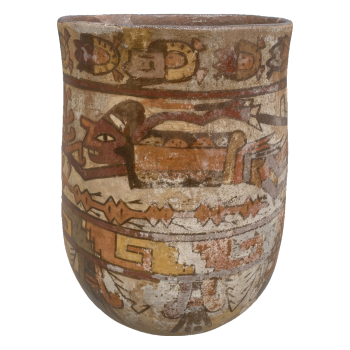
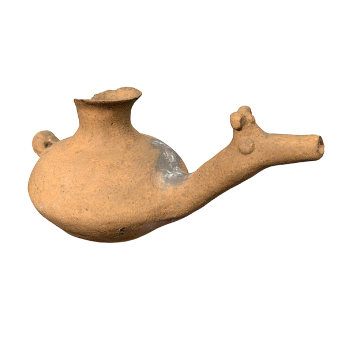
Amphibian Tripod Ceramic Jar
It is a three legged ceramic jar, made around 500 to 800 AD. This ceramic style features hollow three legged pottery jars, decorated with shaping and carving techniques. Especially, it showcases the shaping of human and animal forms, possibly representing a certain type of amphibian and reptile. The discovery of this ceramic style indicates a connection between the Gran Chiriqu í region and the Gran Cocl é region, as Cubit á and Conte style ceramics related to it have been found in the background of Gran Chiriqu í.
Spherical pottery jar
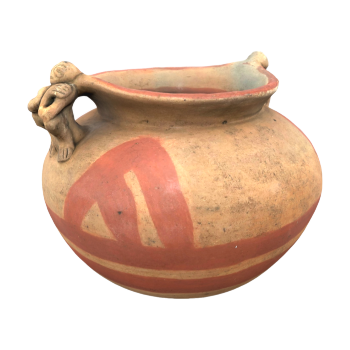
It is a type of spherical pottery jar discovered in Panamanian archaeology, with unique aesthetic and cultural significance. This type of pottery jar is known for its rounded shape and decorative details, usually with a flat bottomed or slightly raised base. There are various decorative techniques, which may include painting, carving, or additional decorative elements such as small protrusions. These pottery jars are not only used for daily purposes such as storing and transporting water, but may also play an important role in religious ceremonies or social activities. In some cultures, similar spherical pottery jars are believed to be closely related to water and life, and may be used in worship or rituals to pray for rain and harvest.
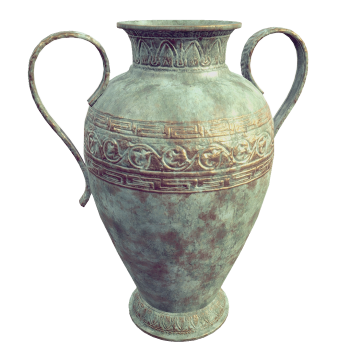
Ancient Greek Terracotta Vase
The terracotta vases of ancient Greece are outstanding representatives of ancient art and craftsmanship. These vases are usually made of red clay, a type of clay that has been fired at high temperatures and has a hard and durable texture. The ancient Greeks used these vases to store liquids such as wine, olive oil, and water, as well as for religious ceremonies and as burial objects. The ancient Greek terracotta vase not only played an important role in practicality, but also an important component of Greek culture and social life. They reflect the aesthetic concepts, religious beliefs, and social customs of ancient Greeks, and are valuable materials for studying ancient Greek civilization.
A pottery jar with a red background, black lines, and a base

The Parita style ceramics from the Greater Cockley region, of the "Arnon" variety, date back approximately between 1150 and 1400 AD. This ceramic jar is characterized by a base and a closure. Its stylistic feature is coated with red paint on the body, decorated with black horizontal lines that run through the can body and base. This decorative technique is a typical representative of Parita style ceramics, reflecting the aesthetic characteristics and craftsmanship level of ceramic art in the region at that time.
Red line decorative pottery jar
It is an ancient ceramic container from the field of archaeology in Panama. This type of pottery jar is characterized by red line decoration, which constitutes its main visual element, showcasing a concise and rhythmic aesthetic. Decorative lines are usually horizontally distributed, which may surround the middle of the pottery jar or create a contrast at the mouth and bottom, thereby enhancing the visual effect and cultural expression of the vessel. This decorative technique not only reflects the craftsmanship level of the craftsmen at that time, but also reflects the unique style and aesthetic tendency of ceramic art in ancient Panama.
Ceramic disc holder with animal image
It is a ceramic plate with a base, belonging to the Parita style, dating back to approximately 1150 to 1400 AD. This ceramic style is characterized by black horizontal lines decorated on a red primer, which run through the plate and base. The Parita style ceramics are significantly different from the colorful ceramic decorative styles of the region before. Many previous decorative elements such as "YC", spiral patterns, design saturation, claws, and lizards have disappeared, but animal shaped decorations are still preserved. This type of plate is a typical representative of Parita style due to its unique base.
Tray with base coated with clawed lizard
This artifact belongs to the Macaracas style and appeared around 1000-1150 AD. Its characteristics are geometric and animal image design, with the left half showcasing Conte style black and purple borders, and thick lines on red and cream backgrounds; The right half showcases Macaracas style saturated decorations, with a central image of a clawed lizard in a color similar to Conte style.
Plato with pedestal like plate
It is a ceramic plate with a base, and this style of ceramic work originated in the Panama region and was made around 1150 to 1400 AD. These plates usually present exquisite painted decorations. These plates were not only used as practical eating utensils, but also reflected the aesthetic taste and cultural beliefs of the society at that time. In the Gran Cocl é culture, similar ceramic works are important archaeological discoveries that showcase the ceramic art and craftsmanship of the region during the pre Columbian period.
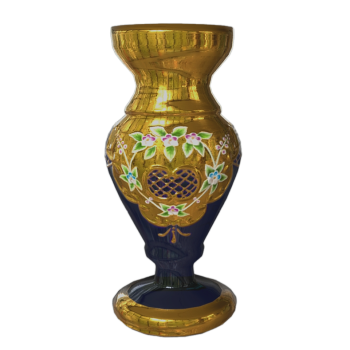
Japanese silver enamel vase
Japanese silver enamel vase is a traditional handicraft that combines art and craftsmanship. This type of vase is usually made of copper or silver and covered with a layer of enamel glaze. After high-temperature firing, it forms a smooth and shiny surface. Enamel has rich colors and diverse patterns, commonly featuring traditional Japanese elements such as flowers, birds, landscapes, and figures. Silver wire craftsmanship outlines delicate lines on enamel, adding a sense of three dimensionality and artistic beauty. The Meiji era (1868-1912) was the peak period of the development of enamel craftsmanship in Japan, and works from this period were particularly favored by collectors.
Striped pattern base tray
The Macaracas style in the Gran Cocl é region was produced between approximately 1000 and 1050 AD. This multicolored ceramic plate features a base and a high saturation of decorative design, retaining some elements of Conte style, such as thick black lines outlining patterns and the use of purple. The typical features of Macaracas style, such as claw and lizard patterns, are replaced by horizontal lines in red and purple, as well as lines resembling bird beaks, all surrounded by thick black lines.
White tailed deer pattern ceramic disc
The Conte style ceramic plate from the Gran Cocl é region dates back to around 700 to 1000 AD. This type of plate features the typical color of Conte style (red circular base, black and red patterns on cream base). The typical pattern at the center of the plate is a white tailed deer (Odocoli virginianus), which repeatedly appears in this style and may symbolize some mythological significance. Remarkably, the claw details in the pattern became more stylized in the subsequent Macaracas style (1000-1150 AD)
Copy Stream Vase
The design inspiration for replicating stream vases usually comes from streams in nature, which may use flowing lines and shapes to simulate the flow of water. Copying stream vases may target a wide range of consumer groups, especially those who like natural style decoration but do not pursue high-value collectibles. Move. The replica stream vase can be made of various materials, such as ceramic, glass, metal, or plastic, depending on the production technology and design requirements The design of such vases may also reflect a concern for environmental protection, reminding people to cherish the natural environment by imitating natural landscapes.
Ceramic disc with humanoid pattern
The Conte style ceramic plates from the Gran Cocl é region were made between approximately 700 and 1000 AD. This dish is known for its iconic Conte style color (red base, black and red patterns on cream base). The center of this plate features a typical humanoid pattern, which appears in multiple plates of the same style, indicating that it may represent an image from some mythology. Especially this specific humanoid pattern has been used in multiple advertising campaigns and has become a well-known popular image.
Panama circular base disk
It is a ceramic plate with a circular base, belonging to the Conte style, made approximately between 700 and 1000 years ago, from the Gran Cocl é region, and now belongs to the archaeological category of Panama. This dish is known for its unique Conte style colors (red, black on cream base, and circular base). The center of the plate usually features a typical animal image, such as a white tailed deer, and is decorated with details such as claws, which become more stylized in the subsequent Macaracas style.
Circular base animal decoration disc
It is a ceramic plate with a circular base and animal shaped design, belonging to the Conte style, made approximately between 700 and 1000 years ago, from the Gran Cocl é region, and now belongs to the archaeological category of Panama. This type of ceramic is known for its unique central pattern, often depicting images of animals or mythical creatures, painted in black and red on a white or cream background, with edges often red. The decorative style of the plate reflects the characteristics of ceramic art during the Conte period, and its central pattern may represent a mythical creature with important cultural symbolic significance.
Silver sacrificial bowl
This silver bowl was created by the famous silversmith Maung ShweYon from Myanmar. The bottom of the bowl is engraved with the silversmith's logo, a sitting deer in a 16 o'clock star, and the silversmith's initials' M. ' S.Y.'。 This bowl depicts ten scenes from Patachara's hard experience before becoming an outstanding Arhat and the main disciple of Buddha. Her story is included in "Therigatha," a collection of poems written around 1880 and currently housed in the Minneapolis Museum of Art
Chinese porcelain vase
Chinese porcelain has a history of thousands of years, with the earliest porcelain dating back to the Shang Dynasty. By the Tang Dynasty, porcelain production technology had become quite mature, and it reached its peak during the Ming and Qing Dynasties. Chinese porcelain vases are usually made of raw materials such as kaolin, quartz, and feldspar, which are fired at high temperatures to achieve a hard texture, smooth glaze, and good transparency. The production process of Chinese porcelain vases includes multiple steps such as drawing, carving, glazing, and painting, each of which requires exquisite skills and strict quality control. The decorative styles of Chinese porcelain vases are diverse, including blue and white porcelain, pink, doucai, underglaze red, etc.
Geometric pattern ceramic plate
It is a ceramic plate with a circular base and geometric pattern, belonging to the Conte style, made approximately between 700 and 1000 years ago, from the Gran Cocl é region. This ceramic plate is known for its unique Conte style colors (red, black on cream base, and red circular base). There is usually a typical humanoid pattern in the center of the plate, which appears in multiple plates of the same style, suggesting that it may represent some mythical image. This work not only serves as a practical dining utensil, but also reflects the aesthetic taste and cultural symbol of the society at that time.
Medieval ceramic bowl
It is a pottery bowl from the medieval period, dating back to approximately between the 14th and 15th centuries. This cultural relic was discovered decades ago in a building near the current History Museum. It effectively showcases the appearance of daily necessities in the Girona region during the medieval period. This pottery bowl was modeled by the Pol Guiu and La Tempesta teams, with text provided by MHG and registration number MHG 8314-158. The detailed information of this model can be found on the official website of the Girona Historical Museum.
Danbo fired pottery
It is a ceramic artwork from the Muromachi period in 15th century Japan, collected by the Cleveland Museum of Art. This pottery jar is made of natural gray glazed stone tools, with a diameter of 39 centimeters and a total height of 45 centimeters. It was once used as a storage container for rice or other grains, and was the work of a potter in the Tanba region, a fertile area located in western Kyoto. This pottery jar is not only practical, but also showcases the aesthetic craftsmanship of Japanese Tanba ceramics. The Cleveland Museum of Art acquired this collection through Severance and Greta Millikin purchase funds.
Indian Warrior Stele
The Museu de Arqueologia in Lisbon, Portugal, houses a work called the Estela De Guerreiro Hindu, which was made in the 10th to 13th and 16th centuries. The back of this artwork is carved with warriors from the Sousa family. The museum is the most important archaeological museum in Portugal, located in Lisbon and founded by Jos é Leite de Vasconcelos in 1893.
A Kashan pottery kettle in the shape of a ram
The "Ram shaped Kashan pottery kettle" is a 13th century Iranian artwork currently housed in the Minneapolis Museum of Art in the United States. This artwork is a water kettle shaped like a ram. This work is part of the Kashan pottery, using transparent turquoise colored glaze and black underglaze painted decoration. Although there are relatively few circular ceramic sculptures in Islamic art, decorative patterns were popular on metal and ceramic vessels in Iran and Türkiye during the Seljuk rule. The shape of a bull is the most common, but there are also vessels in the shape of camels, rams, and lions.
Popular Models
Shrine
115 View
King Kong Hercules Wood Carving
166 View
The bell tower of a Japanese temple
189 View
Japanese Samurai Helmet
117 View
Random Model
3D model of jujube
359 View
Coarse copper short GLB model
333 View
"Strange Things" intercom
187 View
Lycolette Monastery, Belgium
356 View
Horse manure sea urchin fossil
390 View
Tiger Beetle 3D Animated Model
133 View
Cheetah skull
418 View